
Can a fire-damaged home be repaired, or has the structure been weakened beyond repair? The answer isn’t always visible in charred walls or a damaged roof. Fire, heat, and water from firefighting can affect framing and connections out of sight, so structural damage repair after fire starts with a careful assessment. Until the building’s safety has been evaluated, don’t assume it’s safe to enter or occupy.
It’s understandable to feel unsettled when you don’t know what can be saved, what needs rebuilding, or how insurance fits into the work. A restoration team can help organize those decisions. Fire Industry Restoration Experts guides property owners through damage assessment, demolition, and structural rebuilding, while coordinating restoration work with insurance companies.
This article explains how fire can affect structural components and what professionals look for during an assessment. You’ll also learn how decisions about repair, partial rebuilding, or more extensive reconstruction are made, and how the work can progress from assessment to rebuild. Knowing what each step involves can make the next decisions easier to follow.
Key Takeaways
- Fire can compromise framing, load-bearing walls, floors, roof supports, and the connections that help hold a building steady.
- For structural damage repair after fire, assessment identifies affected areas and helps define the work needed before repair or rebuilding decisions are made.
- Follow direction from fire officials and qualified professionals about safe access. Don’t enter areas that haven’t been cleared.
- Whether the right path is localized repair, component replacement, or rebuilding depends on the documented damage and the scope established during assessment.
- A coordinated process can carry the work from documenting conditions through demolition and structural rebuilding, with insurance coordination along the way.
What Structural Damage After a Fire Can Affect
A building can look badly damaged while its supporting frame remains intact, or show limited visible damage while important components need closer inspection. Structural damage is fire-related impairment to the parts of a building that support its weight or help keep it stable. Structural repair restores or replaces those components. Cosmetic restoration addresses appearance, such as smoke residue or damaged paint, without repairing the building’s load-bearing system.
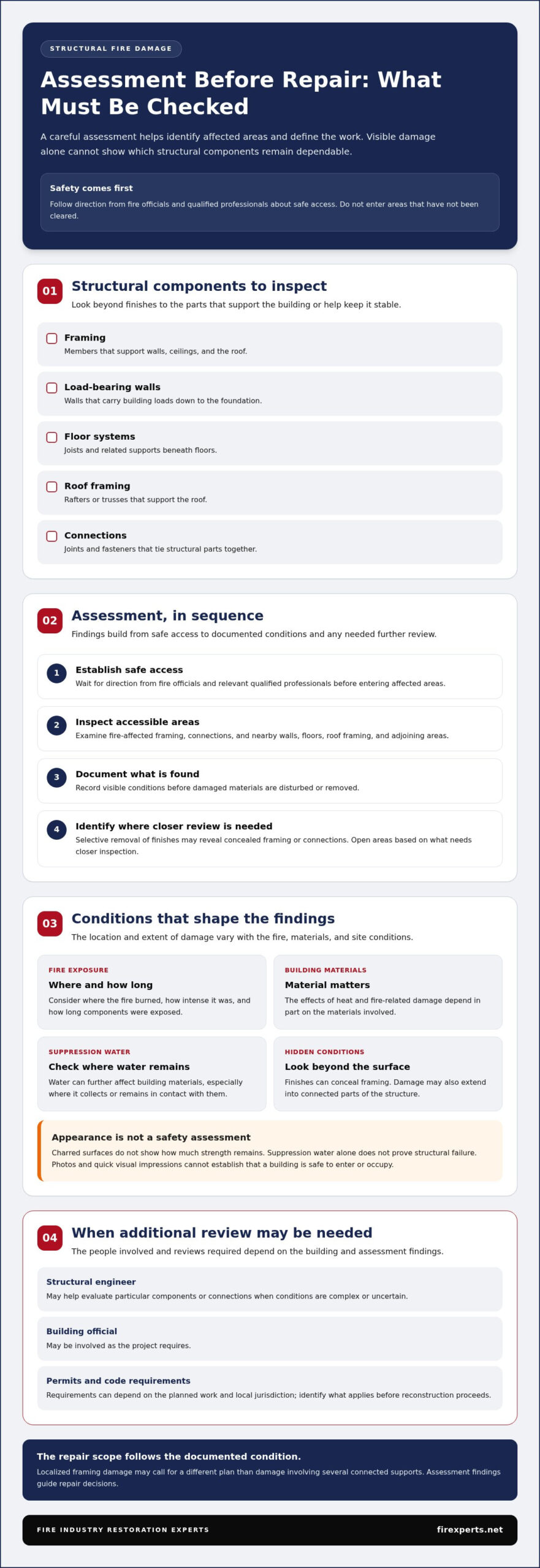
Components that may need inspection include:
- Framing: Wood or other framing members that support walls, ceilings, and the roof.
- Load-bearing walls: Walls that carry building loads down to the foundation.
- Floor systems: Joists and related supports beneath floors.
- Roof framing: Rafters or trusses that support the roof.
- Connections: The joints and fasteners that tie structural parts together.
Damage may be confined to one area or extend across connected components. A general overview of fire damage can help explain why the effects are not limited to what is visibly burned. Determining a building’s condition, however, requires inspection of the structure itself.
How fire, heat, and suppression water affect building components
Heat exposure can affect framing and connections. The result depends on where the fire burned, how intense it was, how long components were exposed, and the materials involved. A charred surface indicates exposure, but it does not by itself show how much strength remains. Components farther from the flames may also need attention if heat or fire-related damage reached them.
Water used to suppress a fire can cause additional damage to building materials, especially where it collects or remains in contact with them. But the presence of suppression water does not, by itself, prove structural failure. The extent and type of damage vary with the building’s materials, the fire’s location, and conditions at the site. For property owners facing post-fire water saturation in the Mid-Atlantic, disaster recovery specialists like atrianglelegacy.com focus on rapid water removal and drying to mitigate further structural compromise.
Why a burned surface does not tell the whole story
Finishes can conceal the framing behind them. A wall may have soot or blistered paint on its surface while the condition of the studs, connections, or materials inside remains unknown. The reverse is also possible: damage that looks modest from one angle may continue behind a finish or into a connected part of the structure.
During restoration, carefully opening selected areas can reveal concealed conditions and help establish how far damage extends. That work should follow safe-access direction from fire officials and relevant qualified professionals. Photos and quick visual impressions can document what is visible, but they can’t establish that a fire-damaged building is safe to enter or occupy. Structural damage repair after fire should be based on the observed condition of affected components, not appearance alone.
How Fire-Damaged Structural Components Are Assessed
A sound repair plan begins with evidence, not assumptions about how severe a fire looked. Structural condition must be assessed before repair decisions are made because visible damage alone can’t show which components remain dependable. A careful assessment helps define the affected areas and gives the next steps a practical basis.
The process follows an orderly sequence: establish safe access conditions, inspect accessible areas, document what’s found, and identify where further investigation is needed. Entry should follow direction from fire officials and relevant qualified professionals. If parts of the building haven’t been cleared for access, don’t enter them to take a closer look.
What the restoration assessment looks at
Once access is established, the restoration team examines fire-affected framing and how structural parts connect and carry loads. This may include checking nearby walls, floors, roof framing, and adjoining areas to determine whether the visible damage is isolated or extends into connected components. The team also documents visible conditions before damaged materials are disturbed or removed, creating a record that supports planning and coordination.
Some finishes may need selective removal to inspect framing or connections hidden behind them. The decision to open an area is guided by what’s already visible and what needs closer review, not by removing more material than necessary. For the wider picture, the fire damage assessment guide explains how structural findings fit within the broader restoration assessment.
When a structural engineer or building official may be involved
Some conditions are complex or uncertain enough to call for a specialized structural evaluation. A structural engineer may help assess particular components or connections, while a building official may be involved as the project requires. Not every fire loss follows the same path. The people involved and the reviews needed depend on the building and the assessment findings.
Permit and code requirements can also depend on the planned work and local jurisdiction. The project team should identify applicable requirements before reconstruction proceeds rather than assume one set of rules fits every property.
Assessment findings guide the repair scope. A localized area of damaged framing may call for a different plan than damage involving several connected supports. Documented conditions help clarify what needs to be removed, repaired, or replaced, and where further review is needed. This keeps structural damage repair after fire grounded in the building’s actual condition rather than a guess based on photographs or surface appearance.
For property owners, coordinating damage assessment, demolition, and structural rebuilding can make the path from inspection to repair easier to follow. Fire Industry Restoration Experts’ structural restoration team can organize that work and coordinate restoration documentation with insurance companies.
Repair or Rebuild? Comparing Structural Fire Damage Options
After a fire, deciding what can be repaired and what needs replacement is rarely a simple choice between saving everything and starting over. The right scope depends on what the assessment documents: how much of the structure is affected, whether damage reaches connected components, and what can be safely accessed and examined. There’s no one-size-fits-all rule. The goal is a sound plan based on the building’s actual condition.
These options describe common levels of work, not automatic outcomes. A limited repair may be appropriate in one area, while damage to connected supports may call for broader replacement.
| Option | Damage extent and connections | Access and assessment scope |
|---|---|---|
| Localized repair | Damage is confined to a defined area, and assessment supports repairing specific components without overlooking affected adjoining connections. | Inspection can establish a limited work area and identify what needs repair. |
| Broader component replacement | Damage affects a larger section or connected framing, so replacing multiple components may be needed to address the full affected area. | Some finishes or damaged materials may need removal to examine connections and set the work scope. |
| Rebuilding | Assessment identifies extensive damage across structural components or interconnected areas that can’t be addressed through a limited repair. | Demolition may expose more of the structure, helping define what must be rebuilt and what can remain. |
When targeted structural repairs may be suitable
Localized repair may suit a clearly defined area when inspection findings support that scope. For example, damage to one portion of framing could lead to a focused repair plan if adjoining materials and connections are also assessed and the work addresses the affected structure. The decision still depends on documented site conditions and applicable project requirements, not appearance alone.
When broader rebuilding may be needed
More extensive or connected damage can require replacing components across a wider area. Demolition may uncover conditions that weren’t visible during the initial assessment, such as damage continuing behind finishes or into adjoining framing. If that happens, the team can document the newly exposed conditions and refine the work scope. The plan may change, but the next decision can then be based on what the structure actually shows.
Keep the decision grounded in evidence. If assessment identifies affected connections, access limits, or areas that need further review, those findings help clarify whether a targeted repair remains practical or broader rebuilding is warranted. Structural damage repair after fire should follow the established scope and relevant project direction, rather than a fixed assumption about what every fire-damaged building needs.
The structural decision is one part of recovery. The fire damage restoration guide outlines the broader sequence of restoration work. Fire Industry Restoration Experts’ structural restoration team coordinates assessment, demolition, and structural rebuilding as part of that process.
The Structural Repair Process From Stabilization to Rebuild
Once the structural scope is established, the work can move forward in clear stages. The sequence may shift as conditions become visible, but each decision should connect to documented findings and the site’s needs. Safe access and any stabilization measures depend on the building’s condition and direction from fire officials and relevant qualified professionals. Where structural shifting or foundation damage is present, structural stabilization contractors like Foundation ResQ help evaluate and reinforce load-bearing bases before reconstruction proceeds.
- Document conditions. Record visible damage and areas identified for further review before materials are disturbed.
- Plan the work. Set the demolition and repair scope based on assessment findings, access, and applicable project requirements.
- Remove damaged materials. Take out materials within the agreed scope to expose affected structural components.
- Repair or replace. Address damaged framing and related components according to the established plan.
- Rebuild. Restore affected areas and keep project records current as work progresses.
Demolition and preparation for structural work
Demolition should follow the documented scope, removing the materials needed to reach affected structural areas without treating the whole building as damaged by default. As finishes and compromised materials come away, newly visible conditions may clarify whether the planned work is sufficient. The team can document scope changes and the conditions behind them, so owners can understand why work may need to adjust.
Rebuilding, code coordination, and project documentation
With affected areas exposed and the scope established, rebuilding addresses the structural components identified for repair or replacement. The work plan should account for applicable permits and code requirements, which vary by project and local jurisdiction. Coordinating those details as part of the project helps keep the sequence clear without assuming every property follows the same path.
Documentation matters throughout. A clear record can include the areas opened, the damage found, the work completed, and any scope changes as conditions become visible. These notes help the property owner understand progress and support practical conversations among the owner, project team, and insurer. They don’t determine coverage or claim outcomes, but they keep project facts organized.
Structural damage repair after fire can involve many moving parts, but a coordinated process connects assessment, demolition, and rebuilding. See how our restoration team can help coordinate the work.
Structural Damage Repair After Fire in Portland: Working With F.I.R.E.
After a fire, owners are left with more than damaged materials. They also face decisions about safety, repairs, rebuilding, and insurance paperwork. Fire Industry Restoration Experts (F.I.R.E.) supports property owners in Portland, Gresham, and Clackamas with restoration and rebuilding work, bringing those steps into one coordinated process.
That coordination matters because structural work rarely happens in isolation. Damage assessment helps define what needs attention. Demolition exposes affected areas for repair, and the findings guide the rebuilding scope. Keeping these stages connected makes it easier to understand why work is planned, how the scope develops, and what comes next.
What owners can expect from a restoration and rebuild team
Clear communication helps keep a project on track. Owners should be able to follow what damage has been observed, what work is proposed, and how progress relates to the established scope. As demolition reveals more of the structure, documenting conditions and changes helps explain adjustments rather than leaving owners to guess why the plan shifted.
F.I.R.E. coordinates damage assessment, demolition, and structural rebuilding as part of the restoration process. The company also coordinates with insurance companies, helping organize restoration documentation and project communication. That support can make the process easier to follow, but it doesn’t promise claim approval or payment. Coverage decisions remain separate from the construction work.
Founder Greg Philo brings a practical perspective shaped by his work as a volunteer firefighter and contractor. F.I.R.E. was founded in 2013, and that background informs a grounded approach to helping owners understand fire-related damage and the work needed to restore a building. The focus is careful assessment, a clear scope, and progress based on documented conditions.
Taking the next step in the Portland area
If you’re discussing structural damage repair after fire, sharing the property’s location and what you know about the damage can help make the conversation useful. Describe which areas were affected, what damage is visible, and whether assessment or demolition has already taken place. You don’t need to have every answer. The restoration and rebuild process can respond to the property’s conditions as they’re documented.
A fire can leave owners unsure about what is safe, what can be repaired, and how to move forward. A clear explanation of the work and coordinated next steps can help make the process easier to manage. Learn about structural fire damage restoration with F.I.R.E.
Take the Next Step Toward a Sound Rebuild Plan
After a fire, it’s natural to want a clear answer right away. A dependable path forward starts with what the property’s documented conditions support, not pressure to decide before the facts are in. Start by organizing assessment notes, insurer correspondence, or existing photos, and write down the questions you still need answered. Don’t enter an area that hasn’t been cleared as safe.
A conversation with a restoration team can help turn those questions into a practical discussion about structural damage repair after fire. Explain what you know so far and discuss how the next project steps can be approached. You don’t need to have every detail figured out before you begin.
When you’re ready, talk with F.I.R.E. about structural damage repair after a fire. The team coordinates assessment, demolition, structural rebuilding, and insurance communication for property owners in Portland, Gresham, and Clackamas.
Frequently Asked Questions
Is a fire-damaged house safe to enter?
Don’t assume a fire-damaged house is safe to enter, even if some rooms look untouched. Wait for direction and appropriate clearance from fire officials before going inside, and don’t move debris or pull away damaged materials to inspect them yourself. If you need to document belongings or damage, follow officials’ instructions about access. Once entry is permitted, a restoration assessment can help identify areas that need closer structural review.
Can fire-damaged framing be repaired instead of replaced?
Yes, framing can sometimes be repaired, but the decision depends on the damage and the condition of nearby components and connections. A limited area of affected framing, for example, may require a different scope from damage that extends into adjoining supports. Assessment findings help distinguish those situations. If demolition reveals additional damage, the repair plan may need to change to address the newly exposed conditions.
Does homeowners insurance cover structural repairs after a fire?
Coverage depends on the specific policy, the circumstances of the fire, and the insurer’s review. Don’t assume every part of the repair will be covered or approved. Keep relevant records, such as assessment documents, project updates, and communications with the insurer. A restoration team can help organize information about the work and coordinate documentation, but can’t guarantee a claim decision or payment.
How long does structural damage repair after a fire take?
There isn’t one reliable timeline for every project. The schedule depends on the damage, the scope of demolition and rebuilding, and any applicable reviews or approvals. Work may need to adjust if removing a damaged finish, for instance, exposes additional affected framing. Ask the project team how it will share progress updates and explain scope changes rather than relying on a generic estimate before the property has been assessed.
Do fire-damaged structural repairs in Portland require permits?
Permit requirements depend on the work and the jurisdiction responsible for the property. A repair in Portland may not follow the same process as work in Gresham or Clackamas, so don’t assume one answer applies across the area. Applicable requirements should be identified for the specific address and planned scope before work proceeds. Permit and review needs can then be accounted for as the repair plan develops.
Can suppression water cause structural damage after a house fire?
Yes, suppression water can affect building materials, but wet materials alone don’t prove that the structure has failed. The location and extent of water exposure matter. Water reaching a ceiling or floor area, for example, is worth documenting for assessment, while the repair scope depends on what inspection finds. Recording where water collected or materials became wet can help the team understand the property’s condition.