
What if the first step after a fire isn’t cleanup, but protecting what’s still standing? It’s natural to worry about people entering through broken windows or doors, while Portland rain reaches exposed rooms and adds to the damage. A fire damage board up service Portland homeowners rely on can help secure openings and begin a careful assessment of the property’s condition.
This guide walks you through what to do after a fire, what professional board-up work can address, and how to start documenting damage for your insurance claim. You’ll also learn what to ask about structural safety and temporary protection, and how to clarify billing before work begins. Insurance policies differ, so don’t assume a cost is covered until you check with your insurer. Board-up is more than putting up plywood: it’s an early step in a restoration process that can protect your home and help you move forward with clearer information.
Key Takeaways
- Learn why prompt mitigation matters and how to document the property’s condition before temporary work begins.
- See what to expect from a fire damage board up service Portland homeowners can use to secure damaged openings with safety in mind.
- Understand how Portland’s rain and humidity can affect fire-damaged materials and why temporary protection deserves careful attention.
- Find out what to ask your insurer about coverage, billing categories, and the records needed to support your claim.
- Use practical questions to compare contractors, including how they assess structural risks and plan beyond the initial board-up.
Why Immediate Board-Up is the Critical First Step in Fire Recovery
After a fire, an open window or damaged roof is more than a security concern. It leaves the home exposed to Portland rain, wildlife, and unauthorized entry, while a weakened structure may be unsafe to approach. Securing the property is an early step toward limiting additional damage and creating a clearer record of what happened.
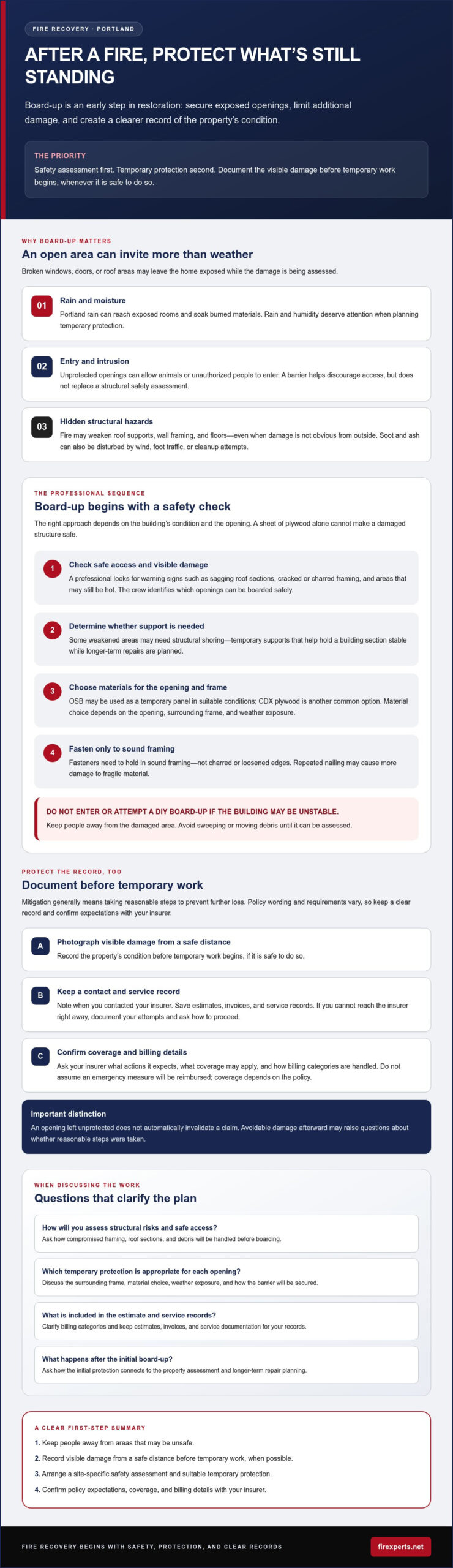
In insurance policies, “mitigation” generally means taking reasonable steps to prevent further loss. The exact wording and requirements vary by policy, so ask your insurer what actions they expect and keep records of your calls and decisions. A fire damage board up service Portland homeowners arrange can help protect exposed areas while documenting the property’s condition. An opening left unprotected doesn’t automatically invalidate a claim, but avoidable damage afterward may raise questions about whether reasonable steps were taken.
Understanding the Duty to Mitigate
Board-up work can show that you acted to protect the home rather than leaving it exposed. Before work begins, photograph visible damage from a safe distance, note when you contacted your insurer, and save estimates, invoices, and service records. If the insurer can’t be reached right away, document your attempts and ask how to proceed. Coverage depends on your policy, so don’t assume every emergency measure will be reimbursed.
Leaving openings exposed can allow rain to soak burned materials, give animals access, or make it easier for someone to enter. Those events can add damage that complicates assessment and recovery. Temporary protection helps limit these risks while the insurer and restoration professionals determine next steps.
Safety Risks of Exposed Fire Damage
Fire can weaken roof supports, wall framing, and floors in ways that aren’t obvious from outside. A structure may look stable but shift when someone climbs onto a roof or fastens boards to a damaged frame. Don’t enter or attempt a DIY board-up if the building may be unstable. A qualified professional can assess safe access and avoid relying on compromised sections for support.
Soot and ash can also be disturbed by wind, foot traffic, or cleanup attempts. Keep people away from the damaged area, and avoid sweeping or moving debris until it can be assessed. For general background on fire safety practices, review guidance on fire prevention and building safety, but rely on a site-specific assessment for this property.
There’s a security and liability concern, too. An accessible, fire-damaged building may attract trespassers or curious passersby. Portland’s dangerous-structure provisions may apply when a damaged building becomes an attractive nuisance or a harbor for unauthorized activity. A proper barrier helps discourage entry, but it doesn’t replace a structural safety assessment. Fire Industry Restoration Experts was founded by a volunteer firefighter and contractor, bringing that safety-minded perspective to fire restoration from board-up through rebuilding.
The Professional Fire Board-Up Process: A Step-by-Step Guide
Secure board-up work starts with a safety check, not a sheet of plywood. A fire can weaken framing behind surfaces that look intact, so entering or fastening material to the structure without an assessment can create new hazards. The U.S. Fire Administration guide advises that some fire-damaged properties need openings boarded to keep people out. The right approach depends on the condition of the building and the opening.
Assessing the Structure for Safe Boarding
Before work begins, a professional checks access routes and visible signs of damage, including sagging roof sections, cracked or charred framing, and areas that may still be hot. The crew identifies openings that can be boarded safely and those that may need additional support first. Structural shoring means adding temporary supports to help hold a weakened part of a building stable while longer-term repairs are planned.
Debris around each opening may need careful clearing so a temporary barrier can sit securely. That doesn’t mean disturbing unstable material or entering an unsafe area; if framing or debris could shift, the work needs to wait for an appropriate safety assessment.
Choosing Materials and Installing the Barrier
Material choice depends on the opening, the condition of the surrounding frame, and exposure to weather. OSB can serve as a temporary panel in suitable conditions, while CDX plywood is another common option for board-up work. Neither material makes a damaged structure safe on its own. Fasteners must hold in sound framing, not charred or loosened edges.
Traditional nailing can be appropriate when the frame is sound, but repeated nails may cause more damage to fragile material. Depending on the opening and framing, a crew may use through-bolts with backing to secure a panel while spreading the load. There is no single method that fits every fire-damaged home. The installer should explain why the selected method suits the site.
Windows and doors need snug coverage that discourages entry without placing unsafe loads on weakened walls. For roof openings, tarps may help shed rain, but they need to be secured without putting workers on an unstable roof. A careful crew considers how water will run off and how edges can be held in place, reducing the chance that Portland rain reaches soot-covered rooms or damaged materials.
Ask the contractor to document the openings, materials, and visible conditions before and after work. If you’re arranging a fire damage board up service Portland homeowners can rely on, choose a team that can explain both the immediate safety plan and how board-up fits into the broader recovery. You can review fire restoration services as one step in understanding that process.
Regional Challenges: Portland Weather and Property Security
Portland’s steady drizzle can keep working on a fire-damaged home long after the flames are out. Burned or heat-weakened wood may absorb water through exposed rooflines and wall openings. Moisture can also mix with soot and ash, forming residue that may be harder to clean and potentially corrosive to some surfaces. Damp, porous materials can hold smoke odors, too, so letting rain and humid air circulate through the structure may complicate later restoration.
A tarp alone isn’t always enough. It needs to be secured for the opening and weather exposure, with seams and edges arranged to shed water rather than funnel it indoors. The right covering should also avoid trapping moisture against wet materials. A professional assessment can help determine whether temporary weather protection is appropriate and how to reduce further exposure.
Combating Persistent Moisture
After a fire, don’t assume a barrier has solved the moisture problem. Ask how the crew plans to manage runoff, protect exposed framing, and check that coverings remain secure. For practical insights on directing exterior water away from vulnerable rooflines and wall assemblies, visit Metro Reconstruction Services, Inc. to see how protective details like kick-out flashing work. Vapor-resistant layers may be suitable in some situations, but sealing damp materials without a plan for drying can hold moisture inside. Keep photos and notes about visible water entry, and share them with your insurer and restoration team.
Openings can invite trespassers, wildlife, or curious neighbors, whether a home is in Portland, Gresham, or Clackamas. A sturdy temporary barrier helps discourage entry, but it doesn’t make an unstable building safe. Keep people away from the damaged area and follow instructions from fire officials before entering or moving debris.
Coordination matters. Fire investigators may need access to examine the scene, and building officials can advise on requirements that apply to stabilization or later repairs. Before covering a potentially relevant area, ask the fire department or investigator whether it has been released for restoration work. Contact Portland’s Bureau of Development Services (BDS) for guidance on applicable permit and building requirements; rules can depend on the work and property. In Gresham or nearby communities, confirm which local authority has jurisdiction rather than assuming Portland procedures apply.
Noise rules can also vary by location and type of work. If equipment or temporary work may affect neighbors, check the relevant city’s current guidance and discuss timing with the contractor. A fire damage board up service Portland homeowners choose should take weather, safe access, evidence preservation, and local requirements into account. That measured approach helps make board-up the start of a well-coordinated recovery, not just a quick fix.
Navigating Insurance for Emergency Board-Up and Mitigation
After a fire, it’s hard to manage repairs and insurance paperwork at the same time. Start by notifying your insurer, asking what temporary protection it expects, and keeping a record of the guidance you receive. Policies differ. Emergency board-up may be considered a reasonable step to protect the property, but don’t assume it falls under Additional Living Expenses, which generally concerns extra living costs when a home can’t be occupied. Ask your adjuster which policy coverage applies and what documentation they need.
Before authorizing work, clarify who will pay the contractor, whether direct billing is available, and whether you could be responsible for charges the insurer doesn’t approve. Don’t rely on a blanket rule that you should never pay upfront or that insurance will cover every cost. Get the scope and payment arrangement in writing when possible. If you’re unsure where to begin, reviewing a structured guide to first steps after a house fire in Oregon can help you prioritize actions and organize the information your insurer will need.
How Direct Billing and Estimates Work
Fire Industry Restoration Experts has direct insurance billing expertise and can coordinate with your carrier, helping reduce the paperwork you must manage during a stressful time. Direct billing doesn’t guarantee coverage or remove your responsibility to understand the agreement. Ask what work is proposed, how the estimate will be shared with the adjuster, and how changes or disputed items will be handled.
Contractors may use Xactimate, an estimating platform that organizes repair tasks and pricing into line items. A standardized format can make an estimate easier to review, but it doesn’t determine what your policy covers or guarantee that the insurer will approve the full amount. Compare the written scope with the adjuster’s assessment and request clarification if work appears missing or an estimate seems too low for the documented conditions.
Document the Work and Preserve the Record
Photos taken safely before and after board-up can show the original damage, each protected opening, and the condition of the structure as work progresses. Keep copies of estimates, invoices, messages with the insurer, and notes about approvals. This record can help the adjuster understand why temporary work was done and give the restoration team useful context when assessing structural repairs.
Board-up is an early part of recovery, not a substitute for a full damage assessment. A clear record connects the immediate protection work to the next stages, including evaluation of fire, smoke, and structural damage. If an estimate leaves out visible work, ask the contractor and adjuster to review the evidence together. Stay factual and specific; photos and itemized documents are more useful than unsupported claims.
If you need help coordinating fire restoration and insurance documentation, contact Fire Industry Restoration Experts to discuss the next steps for your property.
Choosing the Right Portland Restoration Contractor for Fire Stabilization
A contractor’s estimate should tell you more than how openings will be covered. Ask how the company will manage the handoff from temporary work to the next stages of restoration, who will be your point of contact, and how decisions or scope changes will be explained. These answers help you judge whether the team can keep the work organized as the property moves from initial protection toward recovery.
The Advantage of a Firefighter-Contractor Perspective
Emergency response and construction call for different kinds of judgment. A firefighter’s experience can inform how a crew approaches a damaged site, controls access, and communicates hazards, while contractor experience brings practical knowledge of buildings and repairs. Ask how those backgrounds shape the company’s work, and how the crew will explain what it can assess versus what requires another professional’s review.
Fire Industry Restoration Experts was founded by volunteer firefighter and contractor Greg Philo. As you compare providers in Portland, Gresham, or Clackamas, look for straightforward answers, careful documentation, and a willingness to discuss the limits of temporary work. A reliable team should be able to explain its recommendations without pressuring you to make decisions before you understand the scope.
Seamless Transition to Rebuild
Keeping board-up and later restoration with one company can make it easier to carry site records and project history forward. It may also reduce the need to repeat background details as work progresses. Before choosing this route, ask how the company separates temporary protection from later repair work, how approvals are handled, and whether you can review each proposed scope before authorizing it.
Use these questions to compare contractors:
- What license or registration applies to the work, and where can I verify it?
- Can you provide local references for fire restoration projects in the Portland area?
- Who will keep me updated, and how will changes to the work be documented?
- How do you coordinate the transition from board-up to structural restoration?
A fire damage board up service Portland homeowners choose should offer a clear path for communication beyond the first visit. Fire Industry Restoration Experts provides fire restoration from board-up through structural rebuilding. Contact Fire Industry Restoration Experts for support and discuss the options for your property.
Take the Next Step Toward a Safer Recovery
After a fire, securing the property helps limit exposure to weather and unwanted entry while setting up the next stage of recovery. A careful assessment, clear photos, and organized communication with your insurer can make it easier to understand what needs attention and document the work. Coverage depends on your policy, so confirm the details directly with your insurer. In addition to securing the building, prioritizing personal safety and first-aid preparedness is essential after any fire emergency; to find targeted burn dressings and supplies, visit Burn-Fix.
Choosing a restoration team with experience beyond temporary boarding can also help connect stabilization with structural recovery. Fire Industry Restoration Experts was founded by a volunteer firefighter and contractor, serves the Portland Metro area, and has done so since 2013. Its experience coordinating with insurance carriers can help you manage the restoration process with clearer information and support.
You don’t have to sort through every next step alone. Secure your property now with Fire Industry Restoration Experts and start a conversation about a fire damage board up service Portland homeowners can turn to as recovery begins. With steady guidance and a practical plan, you can move forward one step at a time.
Frequently Asked Questions
How much does a fire damage board-up service cost in Portland?
The cost depends on factors such as how many openings need protection, their size, access to the damaged area, and the work needed to secure the surrounding structure. Because each fire affects a home differently, request a written, itemized estimate before authorizing service. Ask what the estimate includes and whether the contractor can coordinate billing with your insurer. F.I.R.E. Restoration has experience coordinating directly with insurance carriers, but coverage and payment responsibilities vary.
Will my insurance cover the cost of emergency board-up services?
Many property policies cover reasonable emergency measures to protect a home, but the terms, limits, and approval process depend on your policy. Contact your insurer, report the fire, and ask how it classifies board-up work and what records it needs. Don’t assume the cost falls under Additional Living Expenses, which generally concerns extra costs of living elsewhere. Save photos, estimates, invoices, and claim communications, and confirm your payment arrangement with the contractor.
How quickly can a board-up crew arrive at my property after a fire?
Arrival time depends on the contractor’s availability, the location, site access, and whether officials have cleared the property for work. Don’t rely on an unconfirmed arrival promise. When calling, explain which openings are exposed, whether the roof or walls appear unstable, and whether fire investigators still need access. Ask for a realistic arrival estimate and what to do while you wait. Keep people away from damaged areas and follow directions from emergency officials.
Can I board up my own house after a fire to save money?
It’s safer not to attempt a DIY board-up if fire may have weakened the roof, walls, window frames, or floors. Damage can be hidden, and climbing or fastening boards may put you near unstable materials. A professional can assess access and determine whether an opening can be boarded safely or needs additional support. If you’re considering a fire damage board up service Portland residents can use, ask how the crew will assess structural safety before installation.
What happens if I don’t board up my fire-damaged property?
An unprotected home may be exposed to rain, wildlife, and unauthorized entry. Water entering through a broken window or roof can add damage to already weakened materials, while an open building may attract trespassers or curious passersby. Leaving the property exposed could also raise questions about whether reasonable steps were taken to limit further loss, depending on your policy. Photograph the damage from a safe distance, contact your insurer, and ask what protective action it recommends.
How long does the board-up material need to stay on my house?
Board-up materials generally remain until the openings can be safely repaired or another suitable protection plan is in place. The timing depends on the structural assessment, insurance process, permits where applicable, and repair schedule. Don’t remove panels or tarps yourself if the building may be unstable. Ask the restoration contractor to explain what condition needs to be met before removal and how the temporary protection will be checked or adjusted during recovery.
Does boarding up a house prevent smoke odors from spreading?
Boarding up can limit outside air movement through exposed openings, but it doesn’t remove smoke residue or guarantee that odors won’t travel inside or beyond the home. Soot and smoke can remain on surfaces and within materials, and conditions differ from room to room. Avoid disturbing ash or soot yourself. Ask a restoration professional to assess smoke damage and discuss appropriate next steps after the property is secured.
Do I need a permit for emergency board-up in Portland?
Permit requirements can depend on whether the work is temporary protection, structural stabilization, or part of permanent repairs. Don’t assume the same rules apply to every fire-damaged property. Contact Portland’s Bureau of Development Services to confirm requirements for your specific work, and ask the contractor whether permits or other approvals may apply. If the home is in Gresham or Clackamas, check with the relevant local authority, since Portland requirements may not apply there.