
Wiping away soot and spraying deodorizer won’t protect a home when extreme heat has compromised the timber framing underneath. Real fire damage restoration Portland OR property owners can depend on demands the practical skill of seasoned builders, not just a surface cleanup crew. Facing the sudden aftermath of a blaze is exhausting. You’re likely staring down confusing claim paperwork, worrying about hidden structural damage, and dreading the stress of juggling multiple trades during an already vulnerable time.
You don’t have to carry that burden alone or guess whether your living space is truly sound. This guide walks you through the entire fire restoration and structural rebuilding process in Portland, giving you the clarity needed to settle insurance claims fairly and restore your property with confidence. We’ll break down everything from initial site stabilization and local code standards to complete structural framing, so you know exactly what genuine recovery looks like every step of the way.
Key Takeaways
- Learn why comprehensive fire damage restoration Portland OR requires licensed structural carpentry to address hidden framing damage, not just surface soot cleanup.
- Discover the five systematic phases of complete recovery, walking you step by step from emergency board-up through framing reconstruction.
- Understand the critical difference between national cleaning franchises and local builder-restorers who can manage both mitigation and full structural rebuilds.
- Find out how standardized insurance estimating works so hidden smoke corridors and water damage are accurately documented without unexpected costs.
- See how working with a single qualified craftsman eliminates the exhaustion of managing multiple independent trades during an already stressful recovery.
Understanding Fire Damage Restoration in Portland OR: Beyond the Char
When the fire department packs up their hoses, the true condition of your property remains largely concealed behind blackened drywall and damp insulation. Real fire damage restoration Portland OR homeowners rely on is an engineered construction process that evaluates structural integrity, safely eliminates corrosive contaminants, and rebuilds compromised framing to current building standards. Looking past the visible char reveals an intricate network of damage that demands trade-level carpentry rather than cosmetic cleanup.
Flames quickly weaken load-bearing members, but convective heat does equal harm by warping steel fasteners, splitting timber joints, and softening structural adhesives. At the same time, acidic soot settles across every surface. This residue etches window glass, pits metal fixtures, and deeply penetrates porous drywall within hours of cooling. To understand modern recovery work, property owners often look at the broader disaster restoration process, which recognizes that extinguishing the flames is only the opening chapter of structural reclamation.
The Triple Threat: Fire, Smoke, and Firefighting Water
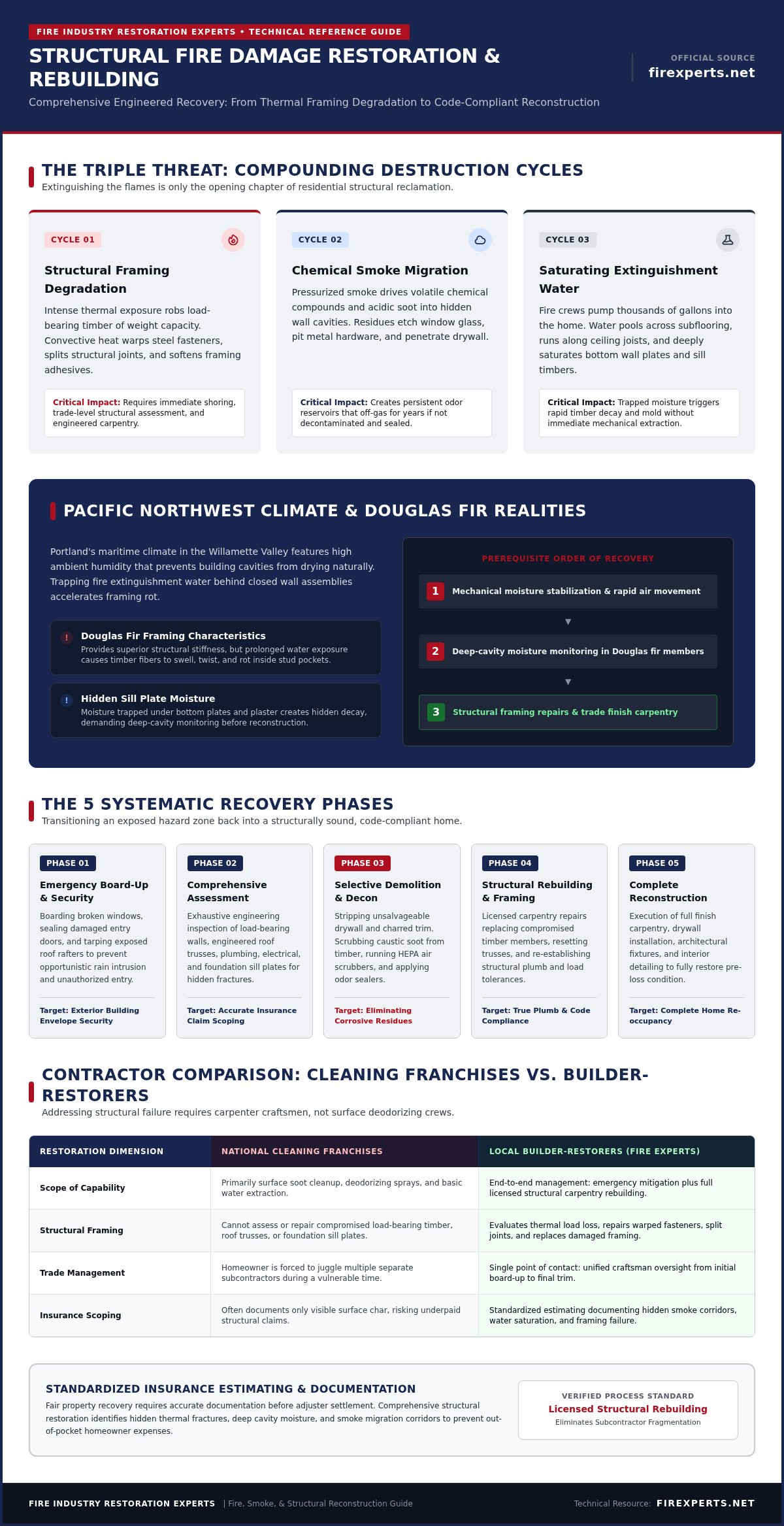
A residential fire creates three simultaneous destruction cycles that compound one another:
- Structural framing degradation: Intense thermal exposure robs structural lumber of its load capacity, requiring immediate shoring and safety evaluations.
- Chemical smoke migration: Pressurized smoke drives volatile chemical compounds deep into hidden wall cavities, establishing persistent odor reservoirs that off-gas for years if untreated. Understanding the full scope of smoke damage cleanup Portland OR professionals recommend begins with recognizing how far smoke can travel beyond the room where the fire started.
- Saturating extinguishment water: Crews pump thousands of gallons into the home, rapidly pooling across subfloors and soaking bottom wall plates.
Pacific Northwest Climate Considerations for Local Framing
Portland’s distinct maritime environment complicates recovery in ways that national cleaning manuals often overlook. In the Willamette Valley, high ambient humidity prevents building cavities from drying out naturally once closed off. Most local homes rely on regional Douglas fir framing. While Douglas fir provides exceptional structural stiffness, prolonged saturation under cool, damp skies causes the timber fibers to swell, twist, and rot within hidden sill plates and stud pockets.
Trapping that moisture behind wet plaster or drywall creates immediate structural decay. Effective water and structure restoration services in Portland require immediate mechanical moisture stabilization, air movement, and deep-cavity monitoring before any structural framing repairs or finish carpentry can safely begin.
The 5 Phases of Complete Fire Restoration and Reconstruction
Recovering from a severe property fire can feel chaotic, but a methodical approach brings order back to your home. Comprehensive fire damage restoration Portland OR properties require moves systematically through distinct stages. Each step builds on the last, transitioning your house from an exposed hazard zone back into a structurally secure, code-compliant dwelling.
Phase 1 & 2: Board-Up and Comprehensive Assessment
The first priority is weatherproofing and physical security. We board up broken windows, seal doors, and tarp compromised roof rafters to keep opportunistic rain and unauthorized visitors out. As highlighted in the federal resource After the Fire, securing the building shell is essential before any inner restoration can proceed safely.
Once stabilized, inspectors conduct an exhaustive framing, plumbing, and electrical assessment. We inspect load-bearing walls, engineered roof trusses, and foundation sill plates. Documenting every hidden fracture and thermal failure ensures your insurance adjuster includes the true scope of reconstruction rather than just surface repairs.
Phase 3: Selective Demolition and Thermal Decontamination
Controlled demolition strips away unsalvageable drywall, ruined insulation, and charred trim without unsettling sound structural components. After stripping ruined materials, crews begin deep decontamination:
- Scrubbing caustic soot residues off exposed timber before they corrode structural fasteners.
- Deploying commercial HEPA air scrubbers to trap fine carbon particulates continuously.
- Treating bare lumber surfaces with specialized sealers that permanently lock in residual odors.
Phases 4 & 5: Structural Rebuilding to Pre-Loss Condition
The final chapters return your home to true plumb and level. Skilled carpenters sister damaged joists, replace burned studs, and install fresh subflooring strictly to the Oregon Residential Specialty Code. Once rough framing clears municipal inspections, trades install new insulation, moisture barriers, and drywall. Partnering with a team experienced in full-scope structure restoration services ensures your framing, drywall, and finish carpentry are executed by qualified local builders who restore your home to its exact pre-loss condition.
Choosing a Contractor: National Franchises vs. Local Builder-Restorers
Who takes responsibility for your home when the soot is wiped away? True recovery requires two distinct skill sets: hazardous material mitigation and licensed structural carpentry. Many national franchise outfits excel at surface cleaning and basic water extraction, but they rarely maintain in-house framing crews. Instead, they often subcontract the rebuild phase to unfamiliar third parties, leaving property owners caught in the middle.
The Difference Between Cleaning Crews and Licensed Contractors
Surface technicians can deodorize drywall and run air scrubbers, but they cannot evaluate load paths, calculate roof loads, or replace cracked structural joists. In Oregon, anyone performing framing repairs or structural alteration must hold an active license with the Construction Contractors Board (CCB), along with mandatory surety bonds and liability coverage. Always verify an active CCB license number before allowing anyone to touch your home’s framing.
Hiring separate companies for mitigation and rebuilding often invites costly friction:
- Finger-pointing: Framers might claim lingering odors were missed by the cleaners, while cleaners argue that new construction dust contaminated treated areas.
- Schedule gaps: Work stalls for weeks while waiting for an independent builder to take over the project site.
- Fragmented accountability: Neither crew takes full responsibility for passing final structural and mechanical inspections.
A unified builder-restorer manages the entire fire damage restoration Portland OR owners depend on, keeping physical accountability under one roof.
Evaluating Local Experience Across Multnomah and Clackamas Counties
Local homes carry unique architectural quirks that out-of-state franchise playbooks overlook. Neighborhoods across Portland, Gresham, and Clackamas feature historic bungalows, Mid-Century ranches, and traditional four-squares built with dense old-growth Douglas fir, lath, and plaster. These materials react to intense heat and moisture differently than modern tract housing.
A local builder understands how to preserve historic components while navigating regional municipal permitting departments without bureaucratic delays. Most importantly, a regional craftsman answers directly to the local community, ensuring the work on your home meets lasting neighborhood standards rather than distant corporate quotas.
Navigating Oregon Property Insurance Claims After a Fire
Filing an insurance claim after a structural loss can feel like speaking a different language. Insurance adjusters carry heavy caseloads, and their goal is to close files quickly using automated estimating software. While this software standardizes trade costs, an adjuster who walks your property for thirty minutes can easily overlook concealed framing issues. Having a builder who understands fire damage restoration Portland OR policies stand firmly beside you protects you from paying out of pocket for damage the blaze caused.
Understanding Standard Property Loss Scopes and Billing
Professional restoration builders communicate with carriers using standardized line-item estimating systems. Instead of vague lump sums, this format documents every individual task required to restore your house. It accounts for selective demolition, soot decontamination, specialized drying equipment, and framing lumber down to the exact linear foot.
When you partner with a turnkey builder, direct insurance billing takes the financial friction off your shoulders:
- Detailed line-item scopes are submitted directly to the insurance adjuster for pre-approval.
- Approved payouts move directly between the carrier and the contractor as rebuild milestones pass inspection.
- You avoid fronting substantial personal savings or juggling complicated draw requests during an already stressful transition.
Preventing Common Scope Gaps and Adjuster Oversights
The biggest threat to a complete recovery is an incomplete initial scope. Adjusters often view damage through a cosmetic lens, budgeting for fresh paint while missing charred subfloors or smoke-saturated insulation in hidden floor cavities. In roof assemblies, high heat causes engineered truss plates to warp slightly, ruining the roof’s structural load capacity without showing obvious burn marks.
Under Oregon law, homeowners are entitled to have their residence restored to true pre-loss condition, matching existing architectural materials and meeting current building codes. If an adjuster disputes structural repairs, your contractor advocate can request formal engineering reviews and submit photographic proof of thermal distortion to secure appropriate supplemental funds. If you need steady advocacy and direct claim handling for your home, schedule an on-site structural damage assessment with our experienced team.
Restoring Your Home with Fire Industry Restoration Experts
When fire strikes, you need an ally who understands what happened to your home and how to rebuild it with lasting integrity. Founded in 2013 by volunteer firefighter and licensed general contractor Greg Philo, Fire Industry Restoration Experts bridges the critical divide between emergency mitigation and skilled structural construction. Serving homeowners throughout Portland, Gresham, Clackamas, and Gladstone, our crew provides dependable, single-source fire damage restoration Portland OR families can trust from the initial board-up to the final coat of paint.
The Firefighter and Builder Advantage
Most restoration outfits approach a burnt structure strictly from an office estimating perspective. Our field background provides a practical grasp of fire dynamics, thermal convection, and how high heat travels through floor framing, chase ways, and attics. We know where hidden charred pockets lurk behind wall cavities because we’ve seen them actively burn from the front lines.
That tactical fire knowledge pairs with genuine trade craftsmanship. Rather than slapping cosmetic drywall over heat-stressed timbers, we focus on structural longevity:
- Meticulous carpentry that restores your home’s structural framing to strict code compliance.
- Thorough soot and smoke elimination using proven, trade-tested methods.
- Direct insurance advocacy that shields you from adjuster pushback and unfair line-item exclusions.
We believe in calm, transparent communication. By managing the physical labor and bureaucratic claims simultaneously, we take the heavy lifting off your shoulders so you can focus on caring for your family.
Starting Your Property Recovery Without Delays
Rebuilding your life begins with an honest, ground-level assessment of the real damage. We arrive on site to inspect structural lumber, evaluate water intrusion, and document every impacted element with complete transparency. From there, our builders coordinate directly with your carrier’s adjuster to establish an accurate scope of work that protects your investment.
You don’t have to carry the emotional weight of this crisis alone. Contact Fire Industry Restoration Experts to speak with a seasoned local builder who is ready to listen, stand in your corner, and restore your home the right way.
Rebuilding Your Home and Peace of Mind
Recovering from a house fire is undeniably exhausting, but restoring your property doesn’t have to be a battle. Lasting recovery depends on treating fire as a structural construction challenge, not a superficial cleaning job. By insisting on thorough framing inspections, protecting local lumber from trapped moisture, and holding insurers accountable to fair line-item scopes, you safeguard both your family’s safety and your financial investment.
Founded in 2013 by a volunteer firefighter and licensed contractor, our crew delivers end-to-end structural rebuilds across Portland, Gresham, and Clackamas. We step into your corner with direct insurance billing and steady owner advocacy, taking the friction out of adjuster meetings and rebuild logistics. When you need dependable fire damage restoration Portland OR homeowners can truly lean on, partner with local structural fire specialists at Fire Industry Restoration Experts. Your home protected you, and with the right craftspeople by your side, it will stand sturdy and safe once again.
Frequently Asked Questions
How quickly should fire damage restoration begin after the fire is out?
Emergency stabilization should begin as soon as the local fire marshal clears the property for entry. Waiting allows standing firefighting water to soak deep into Douglas fir framing, while acidic soot actively etches glass and fixtures. In our wet climate, trapped water accelerates structural rot within days. Boarding up roof breaches and windows immediately stops rain intrusion and prevents additional property loss.
Can I stay inside my home while fire restoration work takes place?
You should generally stay elsewhere until structural integrity and indoor air quality are certified safe. Comprehensive fire damage restoration Portland OR projects involve airborne particulate hazards, compromised joists, and soot residues that carry toxic chemical compounds. Utilities are also disconnected during framing repairs. Most homeowners policies provide loss-of-use coverage, which pays for temporary housing while your property undergoes structural repairs.
What is the difference between fire mitigation and fire reconstruction?
Mitigation stops active destruction, while reconstruction rebuilds the physical structure to pre-loss condition. Mitigation involves emergency board-up, water extraction, and removing caustic soot layers from surfaces. Reconstruction is licensed carpentry work. It involves pulling municipal permits, sistering compromised rafters, replacing charred studs, hanging fresh drywall, and reinstalling trim. Beyond structural framing, finishing stages often extend to kitchen woodwork and cabinetry; for insight into how specialized contractors renew damaged surfaces, learn more about Cabinet refinishing Denver. Full recovery requires smooth coordination across both phases.
Standard homeowners insurance policies typically cover full structural rebuild costs up to policy limits, minus your deductible. Coverage pays to restore framing, roof trusses, subfloors, and finishes back to sound condition. However, insurance carriers require detailed line-item scopes to approve payment. Partnering with a builder who provides direct insurance billing ensures necessary structural work and code updates are fully covered without unexpected out-of-pocket bills.
How do restoration contractors eliminate stubborn smoke odor from wood framing?
Contractors eliminate smoke odor by physically removing charred wood, decontaminating remaining framing, and sealing the lumber. Thermal pressure drives smoke deep into porous wood grain where simple deodorizing sprays cannot reach. Builders mechanically scrub the exposed timber, run commercial HEPA air scrubbers to capture fine particulates, and apply specialized shellac or vapor-barrier sealants to lock odors into the lumber permanently. For a detailed look at how providers approach this work, our guide to smoke damage cleanup Portland OR homeowners rely on explains what a thorough assessment covers and what questions to ask before work begins.
Do I have to use the restoration company recommended by my insurance company?
No, Oregon property owners have the legal right to hire whichever licensed contractor they choose. Insurance companies maintain preferred vendor networks primarily to streamline their own administrative costs. You aren’t obligated to use their list. Selecting an independent local builder ensures your contractor acts as your advocate, prioritizing true structural integrity rather than minimizing repair expenses for the insurer.
How long does full structural fire damage repair typically take in Portland?
A full structural fire damage restoration Portland OR project can take anywhere from a few weeks to several months depending on the extent of the damage. Minor single-room incidents resolve quickly once dried, while severe fires requiring truss replacement, permit reviews, and framing inspections in Portland, Gresham, or Clackamas demand more time. A unified builder keeps the schedule steady without trade handoff delays. This reconstruction phase is also the ideal window to upgrade active protection systems; property managers and builders can buy fire sprinkler heads online and work with certified installers to ensure modern fire suppression is integrated seamlessly before walls and ceilings are closed.