
What if the board-up is only the first step, not the fix? After a fire, storm, or impact, an opening can leave your Gresham property exposed to weather, unwanted entry, and further damage. An emergency board up service Gresham property owners can count on should secure the damaged area and help set the next steps in motion.
It’s understandable to want an opening covered quickly, then wonder what needs to happen before permanent repairs begin. A careful response starts with assessing the visible damage, securing exposed areas, and documenting the property’s condition. Board-up provides temporary protection, not a substitute for a restoration plan, and insurance communication can add another layer of stress.
This guide explains when board-up may be needed, what the work should address, and how it can lead into assessment, mitigation, and rebuilding. You’ll also learn how a restoration team can organize the process and coordinate with your insurance company, helping you move from immediate protection toward lasting repairs with a clearer plan.
Key Takeaways
- Learn which damaged openings may need temporary protection and why the right measure depends on the opening and visible damage.
- See how an emergency board up service Gresham property owners can use can move the work from securing a property toward restoration.
- Compare service scopes by looking at the opening, temporary protection, work documentation, and follow-up plan.
- Keep photos, dates, service notes, and claim communications together to support clear conversations with your insurer.
- Understand how F.I.R.E.’s emergency-response experience and construction expertise can guide the next steps after board-up.
When does a Gresham property need emergency board-up?
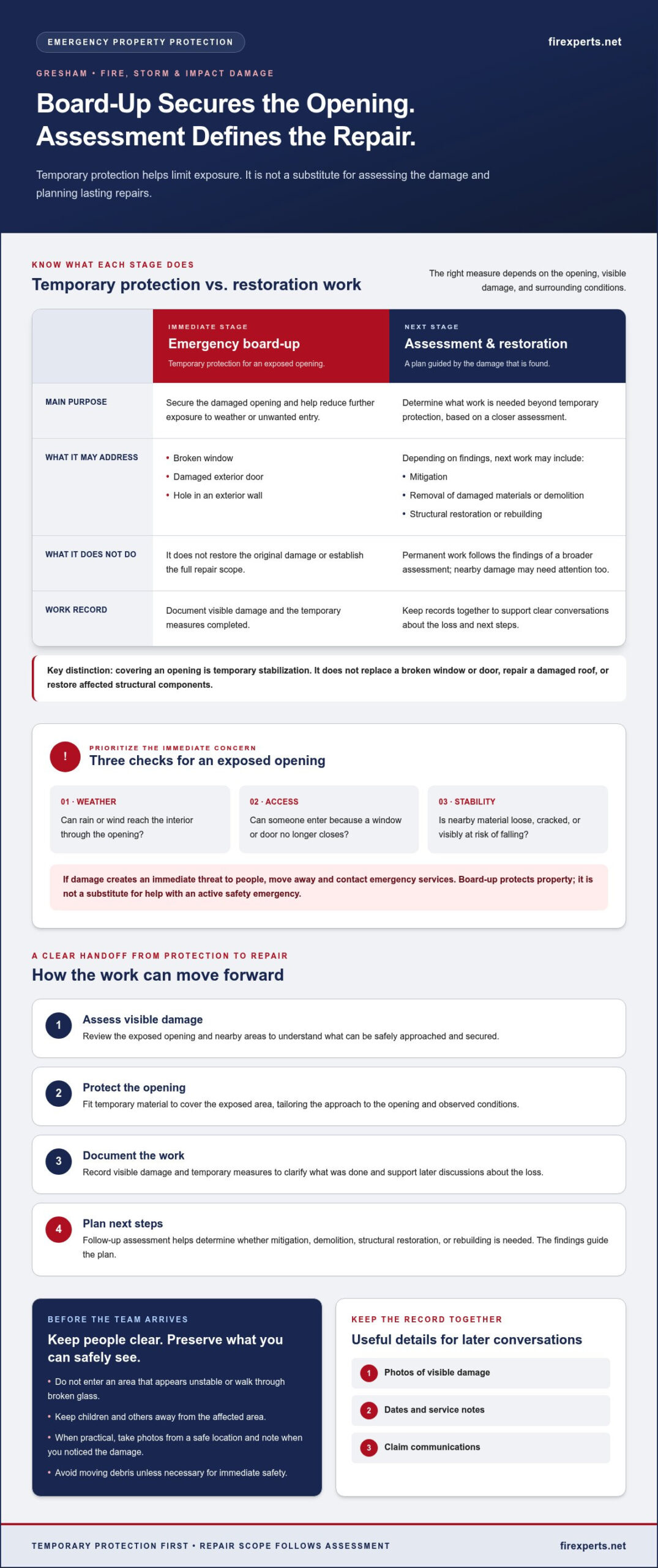
Board-up temporarily secures damaged openings after a loss. If a broken window, damaged door, or hole in an exterior wall leaves the inside exposed, prompt protection can help limit further exposure to weather or unauthorized access while the damage is assessed. An emergency board up service Gresham property owners use should address the exposed opening without implying that temporary protection repairs the original damage.
Prioritize openings that create the clearest immediate exposure. A shattered ground-floor window may leave a room open to wind-driven rain and entry. A damaged exterior door may no longer close or lock. A storm-created hole in a wall can expose building materials and belongings. The right response depends on what’s damaged and whether the opening can be approached safely.
Use this practical check to identify the immediate concern:
- Weather exposure: Can rain or wind reach the interior through the opening?
- Unsecured access: Can someone enter because a window or door no longer closes?
- Possible instability: Is surrounding material loose, cracked, or visibly at risk of falling?
If the damage creates an immediate threat to people, move away and contact emergency services. Board-up protects property; it isn’t a substitute for help with an active safety emergency.
Which kinds of damage can leave a property exposed?
Fire can break windows, damage doors, or leave an opening in an exterior wall where materials have burned away. Storms can crack glazing, push in a door, or tear away part of an exterior surface. These visible openings matter, but they don’t show the full extent of the loss. Heat, water, debris, or damage around the opening may affect what can be safely secured and what restoration work follows.
That’s why the opening itself is only one part of the assessment. The team considers its size, surrounding damage, and nearby hazards before deciding on temporary protection. Board-up can reduce exposure, but it doesn’t restore damaged framing, replace a window, or resolve hidden damage. Those repairs belong to the next stage of the restoration plan.
What should you do before the restoration team arrives?
Keep your next steps simple and safe. Don’t enter an area that appears unstable, walk through broken glass, or try to cover a high or damaged opening yourself. A makeshift repair can put you at risk or disturb damaged materials. Keep children and others away from the affected area, and give responders or restoration workers a clear path if it’s safe to do so.
When practical, record what you can see from a safe location. Take photos from outside the affected area, note when you noticed the damage, and avoid moving debris unless necessary for immediate safety. These observations can help explain which openings were exposed and support later conversations about assessment and restoration. You don’t need to determine the full repair scope yourself. Focus first on keeping people clear and preserving a clear account of the visible damage.
What happens during emergency board-up and what comes afterward?
Board-up is the first protective step, not the complete repair. A sound emergency board up service Gresham property owners rely on follows a clear sequence: review visible damage, secure exposed openings, record the work, and identify what needs attention next. The temporary measure depends on the opening and the damage around it. A broken window and a damaged exterior wall call for different approaches.
Here’s how the work can move forward in practical stages:
- Assess visible damage. The team reviews the exposed opening and nearby areas to understand what can be safely approached and secured.
- Protect the opening. Temporary material is fitted to help cover the exposed area. The approach is tailored to the opening and observed conditions.
- Document the work. A record of the visible damage and temporary measures can clarify what was done and support later discussions about the loss.
- Plan the next steps. Follow-up assessment helps determine whether mitigation, demolition, structural restoration, or rebuilding is needed.
How does temporary stabilization differ from permanent repair?
Board-up covers or secures an opening temporarily. It doesn’t replace a broken window or door, repair a damaged roof, or restore affected structural components. A temporary barrier can reduce exposure, but it doesn’t establish the full repair scope. That requires a closer assessment of the affected building parts and the damage around them.
For example, securing an opening after a fire doesn’t reveal whether nearby framing needs repair or replacement. Permanent work follows the findings of a broader assessment. Keeping that distinction clear helps you understand what the board-up accomplishes and what decisions still lie ahead, whether you are planning standard repairs or major structural renovations such as those featured on powerpillar.co.uk.
How can board-up connect to the larger restoration process?
Once exposed areas are secured, the restoration team can continue assessing the property and identify work beyond the temporary protection. Depending on the findings, that may include mitigation, removal of damaged materials, structural restoration, or rebuilding. These steps aren’t automatic; the observed damage guides the plan. A clear handoff from board-up to assessment gives owners a more organized path forward.
Fire Industry Restoration Experts brings board-up, damage assessment, demolition, mitigation, structural restoration, and rebuilding together under one restoration team. This can make the transition from securing the property to planning repairs more straightforward. For fire-related structural questions, the article Structural Damage Repair After Fire: What Happens Next? explores how assessment leads to repair decisions.
As you review the work, keep the distinction in mind: board-up protects an opening temporarily, while the assessment defines what lasting repairs may involve. To discuss carrying the work forward from protection to rebuilding, talk with a Gresham restoration team.
How should Gresham owners compare board-up service scopes?
A clear scope makes it easier to see what the temporary work will cover and what remains for later. Before work begins, understand which openings will be secured, what the protection is meant to address, how visible damage and completed work will be recorded, and what follow-up assessment is recommended. This gives you a practical basis for comparing scopes without mistaking temporary protection for permanent repair.
Use these four points to organize the details of an emergency board up service Gresham property owners need:
Review what is included before work starts. If a scope addresses a broken window, for example, it should be clear whether it covers that opening alone or other exposed areas as well. Knowing the limits helps you keep records, discuss the work with your insurer, and plan for permanent repairs separately. Board-up protects temporarily; it doesn’t mean a window, door, roof, or structural component has been repaired.
What should a clear board-up scope explain?
A clear scope names the openings being secured and explains the purpose of the temporary protection. It also describes how the team will record visible damage and completed work, then communicate recommended assessment or restoration steps. If further damage becomes apparent during assessment, the next work can be discussed as a separate part of the plan rather than assumed to be included in the initial board-up.
How do property type and damage affect the plan?
In an occupied home, owners may need to understand which areas are affected and how the temporary work relates to daily access. For a managed property, clear records and communication can help keep owners, managers, and other involved parties aligned. Fire and storm damage can affect different parts of a building, so the observed condition should guide follow-up assessment instead of relying on one fixed scope.
For example, storm damage may leave an exterior opening exposed, while fire can affect materials around an opening as well as the opening itself. The initial scope should focus on temporary protection; assessment determines what else may be required. Professional inspection teams such as Fox Claims Consultants can provide detailed storm damage assessments and emergency mitigation insights during this phase. A defined next step gives you a clearer way to move from securing the property toward restoration without assuming that every repair is already known.
How do documentation and insurance coordination fit into board-up?
Clear records help you explain what happened, what damage was visible, and what temporary work was completed. An emergency board up service Gresham property owners use should leave them with a clear account of the work, not a promise about how an insurer will decide the claim. Coverage and claim decisions depend on your policy and your insurer’s review.
Keep related information together so it’s easier to find during a stressful time. A folder, whether digital or on paper, can hold:
- Photos of visible damage and the secured opening, taken from a safe location
- The date the damage occurred or was discovered, and the dates work took place
- Service notes and documents describing the temporary work
- Relevant claim communications, including your own notes from calls with the insurer
What records can help tell the story of the loss?
Time-stamped photos taken before and after stabilization can show the visible condition of an opening and the temporary protection put in place. Don’t risk entering a damaged area or delay a necessary safety measure just to take pictures. If you can’t safely photograph the property beforehand, record what you can afterward and note when the images were taken.
Keep service paperwork with your photos and claim communications. A brief note about which opening is shown in each image can also help you make sense of the record later. These materials support a clear discussion of the damage and work performed, but they don’t determine what an insurance policy covers.
What should owners understand about insurance decisions?
Restoration documentation describes observed damage and the work completed. It is not an insurance coverage decision. Your insurer interprets the policy and reviews the claim, so don’t assume that a documented board-up will be approved for coverage or reimbursed. Keep copies of what you submit and note questions or instructions from the insurer so you can follow the claim conversation consistently.
Fire Industry Restoration Experts coordinates with insurance companies during restoration work. That coordination can connect communication to the property’s assessment and restoration steps, while the insurer remains responsible for its coverage determination. For more guidance on the claim side of fire recovery, see Navigating Insurance Claims for Fire Damage in Oregon.
Good records give you a steadier starting point: what was damaged, what was secured, and what questions still need answers. To connect board-up documentation with the restoration work ahead, discuss your restoration next steps with F.I.R.E.
Choose a Gresham board-up team that can guide the next step
After sudden property damage, it helps to have a clear plan instead of more unanswered questions. Prioritize people’s safety, understand which openings the temporary work will secure, and keep a record of the damage and work completed. Then identify the next assessment or repair step. Board-up should protect the property for now while the restoration plan takes shape.
F.I.R.E. brings emergency-response experience and construction knowledge to this work. Founded in 2013 by volunteer firefighter and contractor Greg Philo, Fire Industry Restoration Experts handles board-up alongside damage assessment, demolition, mitigation, structural restoration, and rebuilding. That continuity can help owners move from temporary protection toward a clearer understanding of the work their property needs.
Why can one restoration team simplify the recovery?
When board-up and restoration work connect, the team securing an opening can carry information about the observed damage into the next assessment. The findings then guide whether mitigation, demolition, structural repair, or rebuilding is appropriate. F.I.R.E. also coordinates with property owners and insurance companies during restoration projects. This supports communication about the work, but the insurer makes its own coverage decisions.
For a wider look at recovery after a fire, Fire Damage Restoration Portland OR: The Property Owner Guide offers broader context. The same principle applies: first protect the property, then let assessment findings guide the repair plan. Clear communication between the owner and restoration team can help keep the transition from one stage to the next organized.
What is the next step for a damaged Gresham property?
Start with the details you can safely share. Note the type of damage, which openings or areas are affected, and whether the property is occupied or managed. Photos taken from a safe location can help explain what you’re seeing. You don’t need to diagnose the full extent of the damage before discussing an emergency board up service Gresham property owners can use to begin protecting the building.
Keep the immediate priorities in view: people first, a clear temporary scope, useful records, and a defined next step. If the damage may extend beyond a window or door, describe what you can see around it without entering an unsafe area. Those details help start a practical conversation about securing the property and assessing what comes next.
F.I.R.E. serves property owners in Gresham, Portland, and Clackamas with board-up and restoration work. If your Gresham property has been damaged, contact the team to discuss the affected openings and the next stage of restoration.
Take the Next Step Toward Recovery
After property damage, it can be hard to know what to handle first. Focus on making safe, informed decisions one step at a time. Share what happened, which parts of the property are affected, and what has already been done to secure them. That gives the restoration conversation a practical starting point without requiring you to have every answer or a complete repair plan.
An emergency board up service Gresham property owners turn to should help bring order to the immediate situation and make the path ahead easier to understand. You deserve clear communication about the work, careful attention to the property, and a next step grounded in what the assessment shows.
If your property has been damaged, talk with F.I.R.E. Restoration about securing your property. A conversation can help you move forward with a clearer plan.
Frequently Asked Questions
How long does emergency board-up stay in place?
Emergency board-up stays in place as temporary protection until the opening can be addressed through the repair plan. The timing depends on the damage, the condition of the surrounding building materials, and when permanent work can proceed. Monitor the temporary protection from a safe location and report any change or damage to the restoration team. Keep the service notes so the next restoration step can account for the work already done.
Does emergency board-up prevent all additional property damage?
No. Board-up helps limit exposure through a damaged opening, but it can’t stop every source of further damage. For example, water may still enter through a separate roof opening, or damage behind a wall may only become clear during assessment. Observe the property from a safe location and report new concerns to the restoration team. An emergency board up service Gresham owners use is one protective measure, not a guarantee against additional loss.
Will homeowners insurance cover emergency board-up in Gresham?
Coverage depends on your policy and your insurer’s review of the loss. Don’t assume board-up will be covered or reimbursed just because it was done to secure the property. Contact your insurer to report the damage and ask how to submit records. Keep the service documents, photos, and claim communications together. Restoration documentation can explain the work performed, but it doesn’t decide coverage or guarantee a particular payment outcome.
Can I board up a broken window myself?
You can take steps to keep people away from a broken window, but boarding it yourself may expose you to sharp glass, unstable framing, or a fall if the opening is elevated. Don’t enter an unsafe area or attempt a repair that requires risky access. If you can safely do so, keep others clear and photograph the damage from a distance. Leave the opening for trained restoration workers to assess and secure.
Is board-up the same as repairing fire or storm damage?
No. Board-up temporarily covers an exposed opening; it doesn’t replace a window or door, repair a roof, or restore materials damaged by fire or storms. For instance, a boarded window after a fire may still need assessment of nearby framing and interior materials. The repair scope follows the damage assessment. Treat board-up as a separate protective measure, then use the findings to plan permanent restoration work.
Should I wait for an insurance adjuster before securing an opening?
Don’t leave an unsafe opening exposed solely to wait for an adjuster. Put people’s safety first and arrange appropriate temporary protection when needed. If it’s safe and practical, take photos before work begins, then keep records of the board-up and any conversations with your insurer. Notify the insurer promptly and follow its instructions about inspection and documentation. A restoration team can record the work, but the insurer determines how the claim is handled.