
What if the damage you can see is only part of the story? After a fire, it’s natural to wonder whether the building is safe to enter and what may be hidden behind walls, ceilings, or floors. A fire damage assessment Oregon property owners can use helps turn those questions into documented findings and a clearer plan, but it is not clearance to enter.
You may already know that charred areas need attention. The harder part is understanding how smoke, soot, heat, and water from firefighting may have affected other parts of the property. A careful assessment can distinguish visible damage from concerns that need further review, while giving you a record to discuss with your insurer and restoration team. It does not decide whether an insurance claim will be approved, but clear documentation can support those conversations.
This guide explains what inspectors commonly check, how findings may be recorded, and what to ask when you receive a report. You’ll also learn what information to document, what an assessment can and can’t tell you, and how initial findings can guide mitigation and restoration. If you’re unsure about entering, take a cautious approach and wait for appropriate guidance before going inside.
Key Takeaways
- A fire damage assessment Oregon property owners receive can organize observed damage and restoration needs, but it is not the same as an insurer’s coverage decision.
- Inspectors may look beyond fire damaged rooms to nearby spaces, building materials, and affected systems.
- Know what details to document and which questions can help you make sense of assessment findings.
- Use a practical sequence to prepare safely, gather useful records, and review the report.
- Clarifying findings and tracking changes can shape the next steps toward mitigation and restoration.
What a Fire Damage Assessment in Oregon Covers and What It Does Not
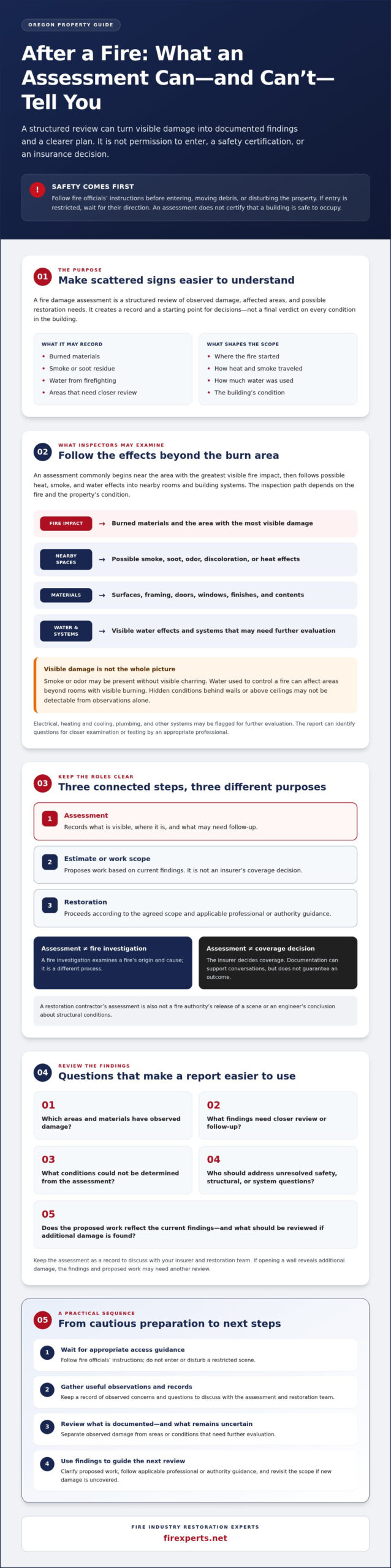
After a fire, it can be hard to tell what’s known, what still needs checking, and what should happen next. A fire damage assessment Oregon property owners arrange is a structured review of observed damage, affected areas, and possible restoration needs. It turns scattered signs of damage into a clearer record and a starting point for decisions.
An assessment may note burned materials, smoke or soot residue, water from firefighting, and areas that warrant closer review. Its scope depends on where the fire started, how heat and smoke traveled, how much water was used, and the building’s condition. A fire investigation, which examines a fire’s origin and cause, is a different process. This fire investigation process overview offers helpful background on that distinction.
Keep the limits in view. A restoration contractor’s assessment is not a fire authority’s release of a scene, an engineer’s conclusion about structural conditions, or an insurer’s coverage decision. Those decisions belong to the relevant officials, qualified professionals, and insurance company. The assessment can document observations and identify questions, but it does not replace their direction or guarantee a particular outcome.
When is a property ready for a fire damage assessment?
Follow fire officials’ instructions before entering, moving debris, or disturbing the property. Assessment timing depends on whether access is allowed, immediate hazards, and site conditions. If officials have restricted entry, wait for their direction. Even after an assessment, don’t assume the building is safe to occupy. The assessment itself does not certify that it is safe.
Assessment, estimate, and restoration: how are they different?
These steps connect, but they serve different purposes. An assessment records observed conditions and areas that may need further review. An estimate or work scope proposes work that may address those findings; it is not an insurer’s coverage decision. Restoration follows an agreed scope and any necessary professional or authority steps. If opening a wall reveals additional damage, the findings and proposed work may need another review.
Think of the sequence as a working plan, not a final verdict:
- Assessment: What’s visible, where it is, and what needs follow up.
- Estimate or scope: What response is proposed based on current findings.
- Restoration: Work that proceeds according to the agreed scope and applicable professional or authority guidance.
Keeping these roles separate helps you understand what a report can answer, who to ask about unresolved concerns, and what decisions still lie ahead.
What Inspectors Examine Inside Oregon Homes and Buildings After a Fire
A fire damage assessment Oregon property owners arrange typically starts near the area with the greatest visible fire impact, then follows possible heat, smoke, and water effects into nearby rooms and building systems. The exact path depends on the fire and the property’s condition. Inspectors may look at surfaces, framing, doors, windows, and contents, recording what they can observe without assuming every hidden condition is detectable.
That component by component approach matters. A scorched door frame may show direct heat exposure, while a room beyond it may have smoke residue or odor without visible charring. Findings help identify affected areas and questions that may need follow up, rather than treating the whole building as if every material sustained the same damage.
How do heat and smoke affect materials beyond the burn area?
Inspectors may note visible soot, smoke residue, odor, discoloration, and changes to finishes or other surfaces. Heat can affect materials differently depending on their location and construction. Those observations don’t always reveal what’s behind a wall or above a ceiling. If something needs closer examination, the report can identify it for further review or testing by an appropriate professional. Cleaning or repair choices should fit the material and observed condition, rather than relying on one method for every surface.
Why do inspectors check water damage and building systems too?
Water used to control a fire can affect areas beyond rooms with visible burning. Inspectors may document damp finishes, staining, or other visible signs, while noting where further evaluation may be needed. They may also flag electrical, heating and cooling, plumbing, or other systems for specialist review. A restoration assessment does not replace evaluation by a qualified professional when a system or structural concern needs specialized judgment.
Ask the assessor to distinguish clearly among what was observed, what remains uncertain, and what requires another professional’s input. For example, a note that a ceiling is stained records an observation; it does not establish the condition of concealed framing. If there are structural concerns, seek evaluation by an appropriately qualified professional and follow direction from relevant authorities. Don’t operate affected systems or enter areas officials have restricted.
For practical guidance on safety and recovery tasks, the U.S. Fire Administration’s After the Fire guide can help you prepare questions and keep track of next steps. Once access is appropriate, a restoration team can explain how its fire restoration services may relate to documented findings and what questions still need answers.
How an Oregon Fire Assessment Documents Damage and Supports an Insurance Claim
A clear record helps turn an assessment into something you can review, share, and ask questions about. In a fire damage assessment Oregon property owners may receive, the report can serve as a working record of observed conditions, not a final ruling on what an insurer will pay. It may include room notes, affected materials, photographs, areas that weren’t inspected, and questions that need follow up.
What should a clear fire damage assessment report include?
Look for specific locations and plain descriptions. “Smoke residue on the hallway ceiling” is easier to understand and discuss than a vague note such as “smoke damage.” The report should also identify uncertainties and recommended next steps, including where a specialist’s review may be needed. If you find unfamiliar terms, exclusions, or uninspected areas, ask what they mean and whether another evaluation is recommended.
Keep your own records alongside the assessment. Save dated photographs taken from a safe, permitted location, notes about what you observed, relevant receipts, and copies of emails or other correspondence. Keep originals where possible and organize copies by date. This makes it easier to track changes, answer questions, and compare later documents.
How do contractor findings relate to the insurance adjuster’s review?
A contractor documents conditions and may prepare a proposed restoration scope based on observed damage. The insurer reviews the claim and makes coverage decisions under the applicable policy. These are separate roles. A contractor’s observations or scope can support your discussions and provide detail for review, but they don’t determine coverage or guarantee approval or payment.
Use the documents to identify exactly where the parties agree or differ. If one record includes a room or material that another doesn’t, ask why and whether more information is needed. Share relevant photographs and records with the appropriate parties, and keep a written note of what each person explains.
| Record or decision | What it addresses |
|---|---|
| Contractor observations | Visible conditions, locations, photographs, and items needing follow up. |
| Proposed work scope | Restoration work recommended based on current findings. |
| Insurer coverage decision | How the insurer applies the policy to the claim. |
Treat the assessment and scope as useful working documents, not promises about the claim outcome. Careful records help you ask focused questions and keep the recovery process grounded in what’s documented.
What Oregon Property Owners Can Do Before and During the Assessment
After a fire, there may be a lot to handle at once. Keep your next steps simple: follow official access instructions, document only what you can safely see, gather useful records, then review the assessment and ask about anything unclear. For a fire damage assessment Oregon property owners can prepare for, safety directions come first. Don’t re enter, move debris, or operate affected systems if officials have advised against it.
What information should you have ready for the assessor?
Once access is allowed, collect what’s readily available. Don’t put yourself at risk or delay an urgent safety instruction to find paperwork. A short list can help keep details together:
- Basic property information and a list of rooms you believe were affected.
- Pre fire photographs, if available, that show the condition of rooms or belongings.
- Claim contact details, your claim number if you have one, and insurer correspondence.
- Dated notes and photographs taken from a safe, permitted location.
You don’t need every record ready before the assessment can begin. Tell the assessor what information is missing and ask how to share additional documents later.
Which questions help you understand the assessment findings?
As the assessor reviews the property or explains the report, ask for clear distinctions between observed damage and conditions that still need evaluation. You can also ask:
- Which areas and materials were inspected, and which could not be accessed?
- What findings are directly visible, and what needs further testing or specialist review?
- What needs immediate protection, and what can wait until the work scope is documented?
- Who will coordinate follow up, access, and any specialist inspection?
Write down answers and note who will handle each next step. If a recommendation or term is unclear, ask for a plain language explanation. It’s reasonable to request clarification before making decisions based on the report.
For properties in Portland, Gresham, and Clackamas, follow instructions from the fire authority involved at the scene. If you’re unsure who to contact or whether access is permitted, check with the relevant local fire authority before entering or disturbing the property. Local direction takes priority over preparing for an assessment.
Once you have the findings and questions gathered, you can discuss fire restoration next steps with a restoration team and clarify how documented conditions may guide the work ahead.
From Fire Damage Assessment to Recovery: Practical Next Steps in Oregon
An assessment gives you a starting point, not a one size fits all repair plan. A steady path forward is to clarify the findings, address immediate property needs, agree on a work scope, and then move into restoration and rebuilding. Each step depends on what the assessment documents and any additional evaluations the property may need.
Sometimes the next work is straightforward. In other cases, opening an area or receiving a specialist’s evaluation may uncover conditions that weren’t visible at first. When that happens, pause to document the new findings, ask how they affect the proposed scope, and confirm what decisions or reviews should come before work proceeds. The plan can adjust as better information becomes available. If rebuilding or safety upgrades involve assessing dedicated fire suppression and sprinkler systems, visit Firemex Solutions Inc. to see how professional fire protection contractors operate.
When might stabilization, demolition, or rebuilding follow an assessment?
These actions depend on documented conditions; not every fire damaged property needs demolition or the same repairs. Fire damage board up service Portland homeowners arrange may be appropriate when immediate property protection is needed, securing openings against weather and unauthorized entry while restoration planning moves forward. Demolition may be considered when findings support removing damaged materials. Rebuilding follows the defined scope and any applicable professional reviews, approvals, or project decisions. Ask what condition supports each proposed action and how it will be recorded.
How can a restoration contractor help you move forward?
A restoration contractor can explain observed conditions, discuss proposed work, and coordinate restoration steps with you. Fire Industry Restoration Experts provides board up, demolition, mitigation, and rebuilding as part of its restoration work. The company was founded in 2013 by Greg Philo, a volunteer firefighter and contractor, bringing fire response and construction experience to the business.
The team also coordinates with insurance companies during restoration. That coordination can help keep documentation and work discussions organized, but the insurer makes coverage decisions under the policy. Ask the contractor to explain what findings support the proposed scope, and direct coverage questions to your insurer. Confirm any needed professional evaluations or authority steps before work moves ahead.
Recovery can feel like a long list of decisions, but you don’t have to sort through every finding at once. If you’d like to talk through your assessment and practical next steps, Talk with Fire Industry Restoration Experts.
Take the Next Step Toward a Clear Recovery Plan
A fire damage assessment Oregon property owners can use helps clarify what inspectors observed, what still needs review, and which restoration decisions come next. Keep the report, photos, and related correspondence together, and remember that a contractor’s findings or proposed scope do not determine insurance coverage. When conditions change or further evaluation is needed, the recovery plan can be updated as new information comes in.
Fire Industry Restoration Experts was founded by volunteer firefighter and contractor Greg Philo. The team coordinates assessment and restoration work with insurance companies, while coverage decisions remain with the insurer. If you’re weighing findings or unsure what to ask next, a conversation can help you sort through the practical steps ahead.
Talk with Fire Industry Restoration Experts about your next steps. Take recovery one decision at a time, with a clearer path forward.
Frequently Asked Questions
What does a fire damage assessment include?
A fire damage assessment reviews visible damage, affected areas, and possible restoration needs. In a fire damage assessment Oregon property owners may receive, a contractor could document burned finishes, smoke or soot residue, heat effects, and water used to suppress the fire. The record may include photographs, locations, observed conditions, and areas that need further evaluation. It guides next steps, but it doesn’t guarantee every concealed condition will be found.
Who performs a fire damage assessment after a house fire in Oregon?
A restoration contractor may assess observed damage and identify restoration needs; fire officials provide scene specific instructions, and a structural concern may require review by an appropriately qualified professional. Fire Industry Restoration Experts, founded by volunteer firefighter and contractor Greg Philo, handles restoration work that includes damage assessment. The company serves property owners in Portland, Gresham, and Clackamas. Ask who will assess each concern and what the assessment does not cover.
Is a fire damage assessment the same as a structural inspection?
No. A restoration assessment documents observed damage and may flag areas that need specialized review. It is not automatically a structural inspection or an engineering conclusion about whether a building is sound. If you see signs of structural concern, or the report recommends further evaluation, ask an appropriately qualified professional to assess it. Follow fire officials’ access directions, and don’t treat a contractor’s assessment as clearance to occupy the property.
Can I enter my home before the fire damage assessment?
Enter only when fire officials’ instructions allow it. If access is restricted, don’t go inside to take photographs, collect belongings, or prepare for an assessment. Avoid moving debris or operating affected systems if officials advise against it. A restoration contractor’s visit does not itself confirm the property is safe to enter or occupy. If you’re unsure about access, contact the relevant fire authority for instructions specific to the scene.
Does a fire damage assessment determine what insurance will cover?
No. A contractor can document observed conditions and may prepare a proposed restoration scope, but the insurer decides coverage under the applicable policy. A report, photographs, receipts, and dated notes can support your claim discussions, yet they don’t guarantee approval or payment. If the insurer’s review and a contractor’s findings differ, ask each to explain the specific items in question and what additional documentation or evaluation may help clarify them.
How long does a fire damage assessment take?
There isn’t one reliable timeframe for every property. The time needed can depend on access, the size and layout of the building, how many areas are affected, and whether water or possible hidden damage needs follow up. Ask what areas the assessor expects to review and whether additional visits or specialist evaluations may be needed. A first assessment may document current observations without settling every question about concealed conditions.
What should I do if an assessment finds hidden fire or smoke damage?
Ask the assessor to document where the concern was found, what was observed, and what still needs evaluation. Share the updated findings with your insurer and keep copies of related photographs and correspondence. Before affected materials are disturbed, clarify what documentation and review are needed, unless immediate safety directions require action. If the concern calls for specialized judgment, ask who should evaluate it and how the findings may change the proposed restoration scope.